
Stablecoins are digital assets designed to maintain a stable value by pegging their price to a reference asset, most commonly the US dollar. Unlike volatile cryptocurrencies such as Bitcoin, they are engineered to hold their value, making them practical for sending, settling and managing money across borders.

Stablecoin payments: an introduction for banks and fintechs
Stablecoin payments: an introduction for banks and fintechs
For decades, moving money across borders meant waiting on correspondent banks and on a settlement process that often took days. Stablecoins are changing that. Stablecoins are a new class of digital asset, built on blockchain networks, which give financial institutions a new way to send and settle payments. Stablecoin payments, operating around the clock, can reduce reliance on traditional correspondent banking chains.
Banks and fintechs are now asking whether blockchain-based payment rails can do what their current systems cannot: settle faster, operate 24/7 and reach places traditional banking infrastructure doesn't. Visa Direct is helping clients across the industry answer that question.
This guide is designed for financial institutions at the beginning of that journey — a clear, practical introduction to what stablecoins are, how stablecoin payments work and why the financial industry is paying close attention right now.
What are stablecoins?
What are stablecoins?
A stablecoin is a type of cryptocurrency designed to maintain a stable value by pegging to a real-world asset, most commonly a fiat currency like the US dollar or euro. Unlike volatile cryptocurrencies such as Bitcoin or Ether, stablecoins are engineered to hold their value over time, making them practical for sending and receiving money across borders.
It’s sometimes useful to think of stablecoin as the intersection of a Venn. In one circle, you have blockchain: global, instant and able to follow instructions. In the other, the price stability of a regular currency. Stablecoins meet in the middle. Most fiat-backed stablecoins, such as USD Coin (USDC) and Tether (USDT), maintain their peg by holding reserves of cash or cash-equivalent assets that back each token issued.
The key innovation isn't the digital format; electronic money has existed for decades. It's more the combination of price stability, 24/7 availability and the ability to move value on a blockchain network without a traditional financial intermediary standing between sender and recipient.
Stablecoins explained: why they exist
Stablecoins explained: why they exist
Cryptocurrencies like Bitcoin introduced the idea of moving value across a global network without a central authority. But they came with a fundamental problem for anyone trying to use them as a means of payment. And that’s price volatility. When the value of an asset can swing dramatically in a single day, it's not much use as a reliable way to store money or pay for things.
Stablecoins were created to solve that problem. By tethering a digital asset to a stable reference – the US dollar being the most common – developers created a form of digital money that could move on a blockchain network, while behaving like conventional currency.
That stability has unlocked a new set of practical use cases:
- A business sending payroll to contractors across multiple countries doesn't want exchange-rate risk embedded in the payments themselves.
- A fintech processing cross-border payouts to freelancers needs the value arriving to be the value that left.
Stablecoins make both of those scenarios possible in a way that volatile digital assets simply cannot.
What are stablecoins used for?
What are stablecoins used for?
Stablecoin payments are being made across a growing range of institutional and commercial use cases.1
Cross-border payments. Stablecoins allow value to move between countries on blockchain networks, bypassing the correspondent banking chains that add cost and delay to international transfers.
Remittances. Individuals and businesses sending money to family or partners abroad can use stablecoins to transfer funds quickly and at a lower cost than traditional remittance services. The recipient converts the stablecoins to local currency via an exchange or on-ramp provider.2
Institutional settlement. Financial institutions are exploring stablecoins as a mechanism for settling transactions between counterparties on blockchain networks, including securities settlement and interbank transfers.
Treasury and liquidity management. Corporations and financial institutions can hold stablecoins as a liquid digital asset while maintaining the flexibility to deploy capital rapidly into payment flows.
What are stablecoin payments?
What are stablecoin payments?
A stablecoin payment is any transaction in which a stablecoin, rather than traditional currency, is used to transfer value between a sender and a recipient. Like a conventional digital payment, it involves moving value from one account to another. Unlike a conventional payment, it does so on a blockchain network, without the need for a chain of intermediaries to validate and settle the transaction.
The differences between stablecoin payments and traditional payment systems are significant:
| Traditional payment | Stablecoin payment | |
|---|---|---|
| Settlement speed | 1–5 business days (cross-border)3 | *Typically minutes to seconds |
| Operating hours | Business hours/cut-off times | 24/7/365 |
| Intermediaries | Multiple (correspondent banks, clearing) | Fewer in general |
| Global accessibility | Limited by banking infrastructure | Any wallet with internet access |
| Programmability | Limited | Native (smart contracts) |
*Actual settlement times may vary based on blockchain network, congestion and implementation.
Have a look at that last row again, it’s important. Because stablecoins live on programmable blockchain networks, stablecoin payments can be embedded with logic, automating recurring transfers, or linking settlement directly to trade finance events. That kind of built-in programmability wasn’t built into legacy payment rails.
How do stablecoin payments work?
How do stablecoin payments work?
Here is how a typical stablecoin payment moves from initiation to settlement:
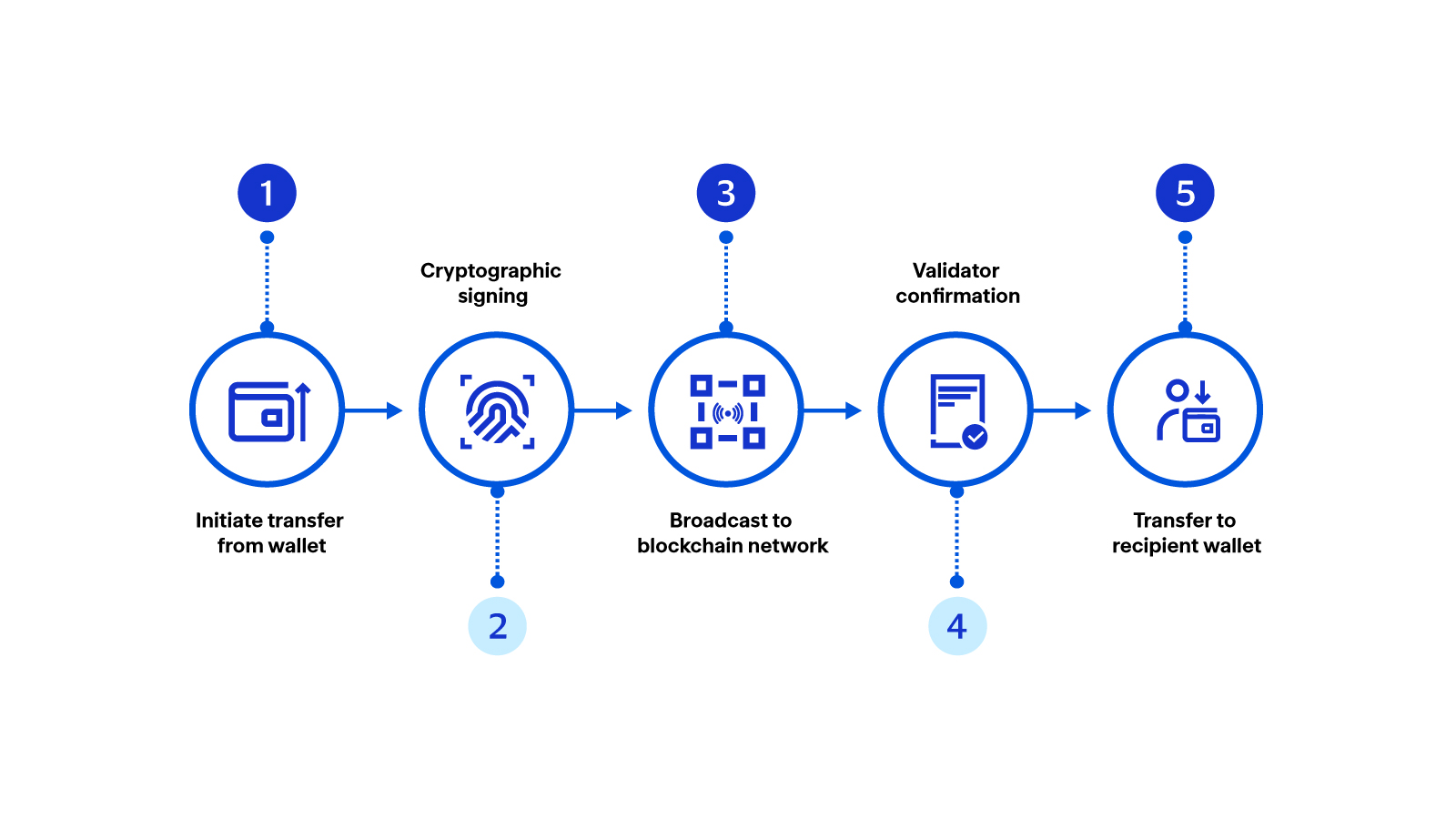
- Payment initiation via wallet. The sender initiates a transfer from a digital stablecoin wallet — either a self-owned wallet or one managed by a financial institution or fintech platform. The sender specifies the recipient's wallet address and the amount to be sent.
- Cryptographic signing. The transaction is signed using the sender's private key — a cryptographic mechanism that proves the sender controls the funds and has authorized the transfer, without revealing sensitive account information.
- Broadcast to the blockchain network. The signed transaction is broadcast to the relevant blockchain network — such as Ethereum or Solana — where it enters a pool of pending transactions waiting to be processed.
- Validator confirmation. Nodes on the network validate the transaction, confirming that the sender has sufficient funds and that the transaction is correctly signed. Once validated, the transaction is added to the blockchain as a permanent record.
- Transfer to recipient. The stablecoin balance is updated in the recipient's wallet. Depending on the blockchain network and current congestion, this process can take anywhere from a few seconds to a few minutes.
The entire sequence replaces a process that, in traditional cross-border payments, can involve multiple banks, currency conversions and days of waiting.
Stablecoins in payment and settlement systems
Stablecoins in payment and settlement systems
A stablecoin payment doesn't happen in isolation. It takes place within an ecosystem of infrastructure providers, each playing a distinct role:
Stablecoin issuers such as Circle (USDC) and Tether (USDT) — create and manage the stablecoin supply, holding reserves that back each token in circulation and publishing attestations of those reserves.
Blockchain networks, including Ethereum, Solana and others, provide the decentralized infrastructure on which stablecoin transactions are validated and recorded. The choice of network affects speed, cost and finality.
Digital stablecoin wallets serve as the interface through which individuals and institutions hold, send and receive stablecoins. Wallets range from individual or business-facing apps to institutional custody platforms with enterprise-grade security controls.
On- and off-ramps are the points at which traditional fiat currency enters and exits the stablecoin ecosystem — typically via regulated exchanges or financial institution integrations that allow users to convert between dollars and stablecoins.
Liquidity providers facilitate the conversion of stablecoins into local currencies at the point of receipt, which is particularly important for cross-border and remittance use cases where the recipient needs local fiat rather than a digital asset.
Visa Direct helps clients integrate stablecoin payment flows through partnerships and network capabilities, while clients remain responsible for issuer selection, custody and compliance — helping financial institution clients move through the stablecoin ecosystem with confidence.
Benefits that stablecoins bring to banks and fintechs
Benefits that stablecoins bring to banks and fintechs
For banks and fintechs, stablecoins address some very specific and longstanding frustrations with how money moves.
Faster settlement. Where traditional cross-border transfers can take one to five business days to settle, stablecoin transactions settle on-chain in minutes — reducing counterparty risk and freeing up working capital.
Lower transaction costs. By removing intermediaries from the settlement chain, stablecoin payments can significantly reduce the fees associated with correspondent banking and international wire transfers.
Global accessibility. Stablecoin payments are available to any party with a digital wallet and an internet connection, regardless of whether they hold a bank account or have access to traditional financial infrastructure.
Built-in intelligence. Because stablecoins run on programmable networks, payment logic can be embedded directly into the transaction itself — releasing funds when conditions are met or linking settlement to real-world events like a shipment arriving.
24/7 availability. Unlike traditional payment systems that operate on business hours and close over weekends and public holidays, stablecoin networks run continuously.
What are the challenges and risks of stablecoins?
What are the challenges and risks of stablecoins?
Stablecoins come with a set of challenges that financial institutions need to understand before moving forward:
Reserve transparency. The stability of a fiat-backed stablecoin depends entirely on the quality and accessibility of its reserves. Not all stablecoin issuers provide the same level of transparency or third-party attestation.
Compliance requirements. Stablecoin transactions still require KYC (Know Your Customer), AML (Anti-Money Laundering) and sanctions screening5 — obligations that fall on the financial institutions and platforms facilitating those transactions, not the blockchain network itself.
Security risks. The risks range from smart contract vulnerabilities to straightforward phishing attacks. Institutional adoption requires enterprise-grade custody and security controls.
Interoperability. Stablecoins issued on different blockchain networks are not always interoperable. Moving value across chains introduces additional complexity and, in some cases, additional risk.
The future of stablecoins in financial services
The future of stablecoins in financial services
Stablecoins are not a passing trend. The infrastructure being built around them — from regulated issuers to central bank digital currency frameworks — points toward a future in which blockchain-based settlement becomes a standard part of the financial system rather than an alternative.
Several developments are shaping that future.
Regulatory clarity
The passing of the Guiding and Establishing National Innovation for U.S. Stablecoins (GENIUS) Act in the U.S. in July 2025 has been the catalyst for regulated stablecoins to become a trusted part of international trade and finance.
The signing of the GENIUS Act establishes a formal framework for how stablecoins are issued, backed and regulated, paving the way for broader adoption in both domestic and global markets. It provides greater regulatory clarity within the U.S. financial system. This is important because for years the industry operated in a gray area. The GENIUS Act establishes a framework, by mandating that issuers must back stablecoins one-to-one with real assets.
With Markets in Crypto Assets (MiCA) the entire EU now has a legal framework for stablecoins, especially those pegged to fiat currencies like the euro. For businesses in the EU, it means they have access to regulated, institutionally accepted digital money. Under MiCA stablecoin, issuers have to follow strict requirements about their reserves – how they are stored and how they are redeemed. Companies have the reassurance that they can access crypto-native money that is compatible with EU regulations and financial partners.
Tokenized deposits
These are bank liabilities represented as digital tokens on blockchain networks. They are being explored by major financial institutions as a complement or alternative to stablecoins for institutional settlement. Central bank digital currencies (CBDCs), under active development in dozens of countries,4 will create new questions about the role of private stablecoins in a partially digitalized monetary system.
For banks and fintechs, the opportunity is to engage now. Build the understanding and infrastructure before stablecoin-based payment rails become a competitive necessity rather than a strategic option. Visa Direct is helping institutions access the benefits of stablecoin payments within a framework that can meet the compliance and security standards financial services demand.
The way money moves is changing. Institutions that understand how stablecoin payments work will be best placed to move with it.

Stablecoins as a money movement rail
Stablecoins as a money movement rail
For a deeper look at how stablecoins function as a money movement rail — and where they fit alongside cards, real-time payments and bank transfers — hear how Visa Direct leaders Julia Kuchman and Cuy Sheffield break it down.
Frequently asked questions (FAQs)
Frequently asked questions (FAQs)
What are stablecoins?
What are stablecoins used for?
Stablecoins are used for a wide range of financial applications, including cross-border payments, remittances, institutional settlement, international payroll and gig-economy payouts and corporate treasury operations. Their 24/7 availability makes them particularly suited to use cases where traditional payment rails fall short.
How do stablecoin payments work?
A stablecoin payment is initiated from a digital wallet, verified by the sender, broadcast to a blockchain network, validated by the network's nodes and settled in the recipient's wallet, typically within minutes. The process replaces the multi-day correspondent banking chain used in traditional cross-border payments.
Are stablecoins safe for payments?
Stablecoins issued by regulated entities with transparent, audited reserves offer a meaningful level of stability and security. However, risks remain—including regulatory uncertainty, variation in reserve quality across issuers, smart contract vulnerabilities and the need for robust KYC and AML compliance. Financial institutions should evaluate issuers and infrastructure carefully before integrating stablecoins into payment flows.
Do stablecoin payments settle instantly?
Settlement times vary by blockchain network, but most stablecoin transactions achieve finality within seconds to a few minutes. This has clarified that they are significantly faster than traditional cross-border transfers, which can take one to five business days. Unlike traditional payment systems, stablecoin networks operate 24/7 with no cut-off times or holiday closures.
More Visa Direct blog posts
More Visa Direct blog posts
Read more perspectives from Visa experts on how Visa Direct supports global money movement and the evolving ways businesses send and receive payments.
Sources/Footnotes/Disclaimer
- Case studies, comparisons, statistics, research and recommendations are provided "AS IS" and intended for informational purposes only and should not be relied upon for operational, marketing, legal, technical, tax, financial or other advice. Visa neither makes any warranty or representation as to the completeness or accuracy of the information within this document, nor assumes any liability or responsibility that may result from reliance on such information. The Information contained herein is not intended as investment or legal advice and readers are encouraged to seek the advice of a competent professional where such advice is required.
- World Bank, Remittance Prices Worldwide , Q3 2025.
- SWIFT Global Payments Innovation (GPI) program documentation.
- Bank for International Settlements, Central bank digital currencies: foundational principles and core features.
- Financial Action Task Force, Updated Guidance for a Risk-Based Approach to Virtual Assets and Virtual Asset Service Providers.
Important information
This document contains forward-looking statements within the meaning of the U.S. Private Securities Litigation Reform Act of 1995 that relate to, among other things, our future operations, prospects, developments, strategies, business growth and financial outlook. Forward-looking statements generally are identified by words such as "believes," "estimates," "expects," "intends," "may," "projects," “could," "should," "will," "continue" and other similar expressions. All statements other than statements of historical fact could be forward-looking statements, which speak only as of the date they are made, are not guarantees of future performance and are subject to certain risks, uncertainties and other factors, many of which are beyond our control and are difficult to predict. We describe risks and uncertainties that could cause actual results to differ materially from those expressed in, or implied by, any of these forward-looking statements in our filing with the SEC. Except as required by law, we do not intend to update or revise any forward-looking statements as a result of new information, future events or otherwise.