

What are Consensus Mechanisms?
What are Consensus Mechanisms?
Blockchains are distributed peer-to-peer systems that are accessible to anyone, yet no single entity can own or control it. Rather than using a trusted third party, agreement is made possible through a consensus mechanism that enables coordination of a distributed peer-to-peer network. Consensus between different distributed parties is what corporate governance might look like in a centralized system since both processes involve coordinating the actions of different parties and coming to an agreement on tasks and decisions. For a blockchain payments network, it is very important to process, settle and validate transactions correctly and prevent double spending. In blockchains, reaching consensus is a crucial part of how transactions are processed and settled. To put it simply, there are resources at stake and reaching consensus in a blockchain network means being able to reach a common state while keeping the distributed nature of the network.
All open public blockchains are based on the idea that they should be able to reach consensus across a distributed network, even when there are conflicts, without putting control in one place. Proof-of-Work (PoW) and Proof-of-Stake (PoS) are the two best-known algorithms to achieve consensus. In this article, we examine both PoW and PoS in terms of their technical architecture, coordination mechanisms and economic incentives to understand their characteristics and trade-offs.
A Brief Overview of Consensus Mechanisms
Distributed systems have existed for a long time. A distributed system is, in its simplest form, a collection of computers working together to accomplish a common objective. But what connection do they have to blockchain? Well, all the advancements that blockchains have made would not have been feasible without the development of distributed systems in the first place. A blockchain is essentially a new kind of distributed system. In a distributed system, several processes (e.g., computers) communicate with one another and work together to achieve a common goal (e.g., solving a computational problem).
The Merge has been discussed in the crypto community at large for a while and the event was successfully completed in September 2022. The Merge, arguably the biggest technical upgrade in Ethereum’s history, was a part of the larger transformation formerly referred to as "Ethereum 2.0," a process that also included the transition of the Ethereum network’s consensus mechanism from Proof of Work (PoW) to Proof of Stake (PoS).
A stack of the various layers involved within a blockchain
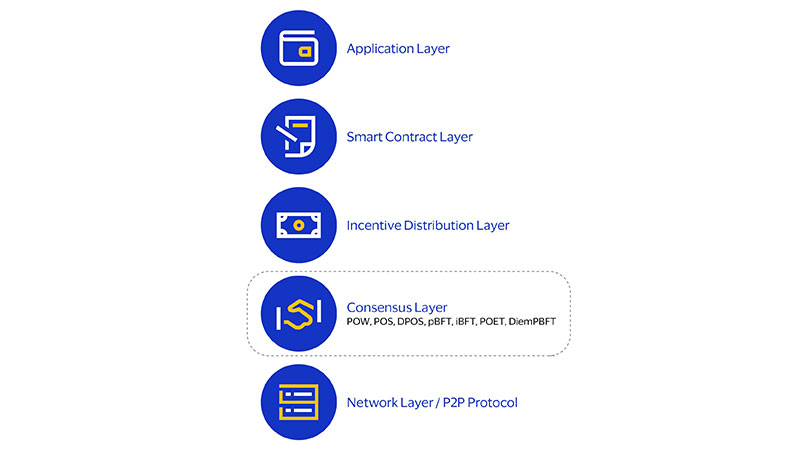
A blockchain is a peer-to-peer, distributed database that is used for maintaining records. Consensus algorithms are essential since blockchains are distributed systems and no central authority checks the data before recording it on the blockchain. The decision of who will publish the subsequent block is a crucial component of blockchain technology. The issue is resolved by putting one of the several consensus models into action. There are typically numerous nodes competing at once to publish the next block in permissionless blockchain networks. The usual motivation for doing this is to earn rewards paid in cryptocurrencies and/or transaction fees. They are typically distinct, independent servers and may only communicate through public addresses. Each node's motivation is probably monetary gain, sometimes not the welfare of other publishing nodes or even the network. Blockchain technology makes it possible for people to cooperate despite their mutual mistrust by using consensus models.
Consensus building in distributed systems is challenging because consensus algorithms need to withstand node failures, network segmentation, message delays, out-of-order message arrivals and corrupted message attacks. They must also cope with selfish and purposefully malicious nodes. To address this, several algorithms have been developed in the research literature, each of which makes the necessary assumptions about synchrony, message broadcasts, failures, malicious nodes, performance and message security. By achieving consensus, a blockchain network may be sure that every node in the network agrees with the same global state of the blockchain. A consensus protocol's applicability and effectiveness can be assessed based on three essential characteristics.
- Safety: If all nodes generate the same output and the outputs are valid in accordance with the protocol's requirements, a consensus mechanism is deemed to be safe.
- Liveness: If all participating, non-faulty nodes eventually produce a value, a consensus protocol assures liveness.
- Fault Tolerance: A consensus protocol offers fault tolerance if it can recover if a participating node goes down.
Depending on the developers behind different blockchains and their respective choice of consensus mechanisms, some consensus processes may prioritize efficiency and speed while others may prioritize security. Payments may benefit from faster consensus formation techniques, although more secure consensus processes may be beneficial in certain contexts, such as supply chain management or high value transactions.
A consensus method combines a Sybil resistance mechanism, an approach to protect the network from an attacker seeking to gain control by amassing a majority of the network’s voting power, with a chain selection rule (aka fork choice rule). In situations where multiple blocks occupy the same position, a chain selection rule enables nodes to select a single correct block at the head of the chain. For example, Bitcoin uses the longest chain rule, which means that the longest version of the blockchain is considered valid by the nodes' participants. For PoW chains, the longest chain is determined by the chain's total cumulative PoW difficulty (to be explained in the PoW section).
The most well-known Sybil attack in the crypto space is the "51% attack," in which attackers take control of the majority of the network's computing power, also known as "hash rate." In such a scenario, the malicious actor could theoretically influence the ordering of transactions, prevent the confirmation of new transactions and double-spend the cryptoasset. Resistance to these attacks is essential for distributed blockchains to function properly. PoW and PoS are effective economic deterrents against Sybil attacks because they require users to expend energy or post collateral in order to participate in network validation. Each validator or miner must have "skin in the game" in order to participate in a distributed cryptographic system, which is the crux of the Sybil resistance mechanism.
Proof of Work
PoW was first coined in the early 1990s, but Satoshi Nakamoto (an anonymous individual or group) was the first to implement the technology for digital currencies. PoW is a significant innovation supporting Bitcoin. The informal term for PoW is "mining," which misrepresents the primary function of consensus. The true purpose of mining is to secure the blockchain while keeping system control decentralized and distributed among as many participants as possible.
Proof of Work
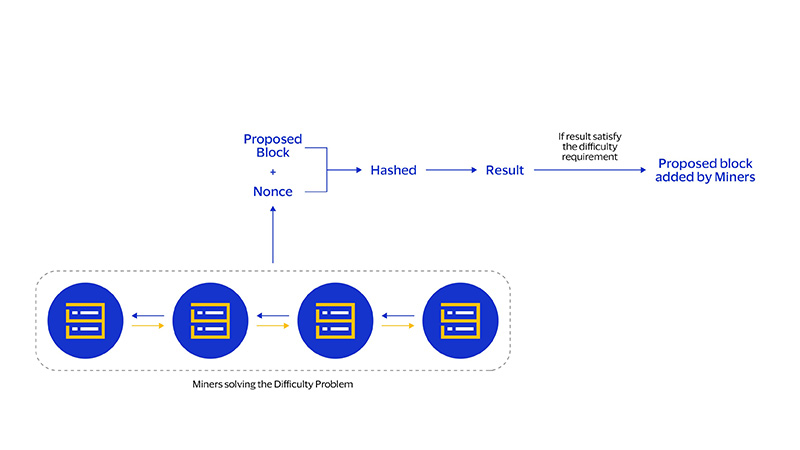
PoW uses dual reward mechanisms (block rewards and transaction fees) to incentivize node participants to be active on the network, ensuring that the network is scalable while retaining its decentralized characteristics. Nodes that successfully solve the puzzle on the Bitcoin blockchain can add their block to the blockchain and receive new bitcoins as a block reward (referred to as the "coinbase"). The rewards are cut in half every four years. Currently, as of November 2022, 6.25 bitcoins are issued per block as rewards, a decrease from 12.5 bitcoins to 6.25 bitcoins in May 2020. In 2024, the block reward is expected to decrease from 6.25 bitcoins per block to 3.125 bitcoins per block, representing the next Bitcoin halving. The second type of reward earned by node participants is the transaction fee. The higher the transaction fee, the more likely it is that a node will validate the transaction, resulting in a faster transaction time. PoW mechanisms enable many nodes to participate in the network, which often makes the network scalable. The probability of a single node controlling the network and conducting fraudulent transactions declines with network size and hashrate. This approach helps make sure the mechanism is strong enough to maintain network security.
In PoW, miners compete to produce a block of data that includes three variables: new transactions awaiting verification, a history of the previous block and a new transaction paying the miners a reward. When the block of data is cryptographically "hashed," this block must satisfy a complex math equation. The network maintains a pool of unconfirmed transactions from which miners can select any transaction they wish to validate. Before adding a transaction to their block, the miner checks that it has the digital signature of the sender and that the sender has already received enough coins in a previous transaction that was also recorded in a block on the blockchain.
Different hashing techniques may be used in PoW blockchains (e.g., bitcoin uses the SHA256 hashing function). In the SHA256 hashing function, a block must have a hash output that is 256 bits long and begins with a specific number of leading zeros in order to be valid (known as the difficulty). By increasing a number known as the nonce and adding it to the block's data, the miner continually modifies and hashes the block, resulting in a unique hash output each time. When it finds a nonce and a set of transactions that satisfy the difficulty criterion, the miner broadcasts the block to other miners so they can verify and accept it. When more miners confirm a block's legitimacy, they add it to their version of the blockchain and begin mining a new block with a hash of the prior block appended. The PoW system of Bitcoin adjusts the puzzle's difficulty every 2016 blocks, resulting in a block publication rate of approximately once every ten minutes. The number of required leading zeros increases or decreases based on the difficulty of the puzzle. By increasing the number of leading zeros, the network makes the puzzle more difficult, thereby reducing the number of potential solutions. With this change, the goal is to keep the puzzle's computational complexity, which is the main security feature of PoW blockchains.
In a PoW blockchain network, nodes must invest time, resources and computation effort to find the appropriate nonce value for the target. The nodes frequently try to solve this computationally challenging puzzle in order to obtain some form of reward. Reward systems or incentive models are terms used to describe the possibility of receiving compensation for extending and maintaining the blockchain. Nodes typically form "pools" or "collectives" in many blockchain networks that rely on PoW, where they collaborate to solve problems and divide rewards. This is possible because a collective can divide work between two or more nodes in order to distribute effort and rewards. Many people say that this shows how centralized PoW chains are, but it's important to remember that miners could stop sending hash power to pools that show signs of wrongdoing because it's not in their best interest to do so.
Proof of Stake (PoS)
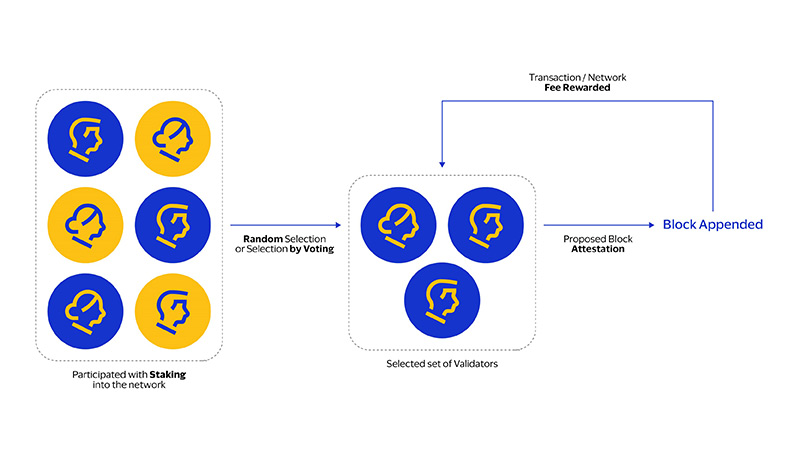
To help address the limitations of the PoW consensus mechanism and reduce the number of computational resources required to maintain the blockchain network, the PoS concept was introduced. While PoW and PoS both share the same goal of reaching blockchain consensus, the process they take is quite different. Rather than expending resources to solve for a computationally intensive proof, participants only prove they have staked coins. PoS "validators" take on the role of "miners," but instead of running crypto mining machines, they are only required to hold and "stake" a certain amount of PoS digital tokens or coins in order to participate in the validation process. In PoS, new blocks are referred to as "minted" or "forged" rather than "mined."
Proof of Stake
Proof of stake image description
Stake is typically the amount of cryptocurrency that a participant in a blockchain network has invested in the network via various methods, such as sending it to a specific address or locking it via a special transaction type. It is possible for stakes to go rogue and validate erroneous transactions. Nonetheless, some protocols have implemented incentive mechanisms to discourage such behavior. For example, in the Ethereum PoS model, malicious validators are punished by having their staked cryptocurrencies confiscated and being prohibited from staking in the future.
The methods by which the blockchain network uses the stake might vary and each option includes trade-offs of its own. As an illustration, a few approaches being used in live blockchain networks include delegate systems, multi-round voting, coin ageing systems and random selection of staked users. In all these variants of the PoS model, the cryptocurrency is typically no longer liquid for other purposes while being staked in the system.
In the long term, in the PoS model, the proportion of a stakeholder's stake to the total sum of cryptocurrency staked on the blockchain network influences the likelihood that they will publish a new block. Therefore, users who have a larger stake are more likely to propose new blocks. Since the PoS eliminates the need for validators to continuously purchase and upgrade hardware, achieving Sybil resistance requires almost no energy consumption and reward mechanisms vary based on the validators' network roles. In the current Ethereum PoS model, for instance, the rewards for block proposals, sync committee members and attestation are highly variable based on the number of Ether staked and the participation rate. These networks are designed so that all the cryptocurrency has already been distributed to users, as opposed to being generated at a constant rate. To learn more about Ethereum's transition from PoW to PoS, refer to our publication titled "What was the Ethereum Merge?."
The following table outlines the basic distinctions/similarities between Proof of Work (PoW) and Proof of Stake (PoS)
Application | Permissionless | Permissionless/permissioned |
Transaction finality | Probabilistic | Probabilistic/immediate |
Trust model | Untrusted | Untrusted/semi-trusted |
Block proposal | Miners | Validators |
Key resource required | Energy/electricity | Crypto/coins |
Cost required | Cost of hardware i.e., Asics/GPU plus energy | Cost to acquire crypto/coins |
Rewards | Coinbase plus transaction/network fees | Transaction/network fees |
Finalizing a malicious block | Hacker would require 51% of computing power i.e., hash rate | Hacker would require 66% of staked coin for adding a malicious block |
Increase in security | Increases with increase in hash rate | More Staking in exchange for rewards |
Forking | Naturally discourages by consensus | Can't be prevented naturally |
Key advantage | Two layers of security are established by the upfront expenditure of the hardware and ongoing energy costs | Owing to its advantages in energy efficiency, PoS blockchain allows ordinary users to take part in the validation process by staking the coins |
Key disadvantage | High energy consumption and a concern with e-waste are driven by improvements in chip speed and efficiency achieved in every few years | Since there is no ongoing cost involved with validating the blocks, centralization at Coin staking level is one of the main issues with its weaker level of security than PoW |
Implementations | Bitcoin, Litecoin, Monero and Zcash etc. | Ethereum 2.0, Solana, Tezos, Cardano, Algorand and Celo etc. |
Conclusion
Consensus-based security is critical for the success of any blockchain to be used for payments, particularly when the use cases involve transferring large amounts of monetary value between network participants and their network users.
The consensus mechanism is therefore the crucial process of building an agreement among a network of mutually distrusting participants in a distributed peer-to-peer network. Participants can propose and process payments for the network in near real-time, as well as agree on the state of the distributed ledger, so understanding the security and decentralization properties of the consensus method is essential in a globally distributed setting. Consensus-building methods help participants reach agreements while preventing anyone from controlling the network.
As one of the largest global payments network, it’s important to actively assess the security and scalability tradeoffs that come with PoW and PoS. We are doing active research to learn about and explore numerous blockchains and how their technical capabilities relate to the payments industry. Contact our team to learn more about our involvement in the crypto ecosystem and the products we are currently building to help expand our capabilities within blockchain payments.
This article is part of a series of articles on Ethereum ecosystem developments. Head over to Stablecoins solutions for more consumer insights, best practices and innovative approaches to the blockchain through our research.