

What was the Ethereum Merge?
What was the Ethereum Merge?
Ethereum reinvented blockchain technology by developing a decentralized state machine or global settlement layer for general-purpose computing. Since the launch of Ethereum in 2015, blockchains are no longer limited to a single, siloed application, and developers are no longer constrained by a limited number of transaction types. Open-source code made it possible for decentralized applications (also known as DApps) to interact with one another, creating a new world of programmable features for blockchain technology. Instant clearance and settlement for peer-to-peer transactions, global transfers and cross-border payments are some of the most prominent use cases for Ethereum. Notably, all of this was made possible while still adhering to the fundamental principles of blockchain, i.e., letting anyone interact with the network in a peer-to-peer trustless and permissionless manner.
Ethereum recently underwent its most significant technological update to date, known as "The Merge," which paved the way for Ethereum to become a more scalable platform in the future. Ethereum has the largest market share in terms of the number of DApps, developer mindshare and new solutions built on top of its base layer, such as various payment solutions. In this article, we explore the specifics of The Merge, its potential ramifications for the blockchain trilemma and the upcoming blockchain upgrades that we are closely monitoring.
What is The Merge?
The Merge has been discussed in the crypto community at large for a while, and the event was successfully completed in September 2022. The Merge, arguably the biggest technical upgrade in Ethereum’s history, was a part of the larger transformation formerly referred to as "Ethereum 2.0," a process that also included the transition of the Ethereum network’s consensus mechanism from Proof of Work (PoW) to Proof of Stake (PoS).
A timeline of major upgrades to the Ethereum mainnet and the Beacon Chain
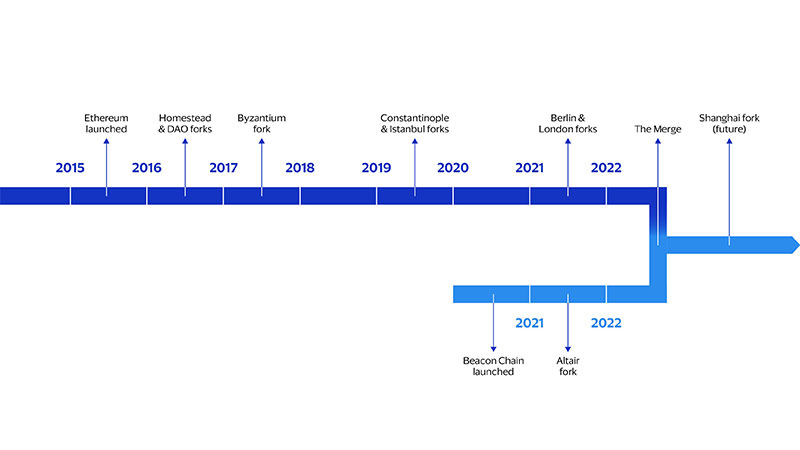
A testnet version of Ethereum, known as the Beacon Chain, was launched on December 1st, 2020. This signified the first step in the transition of the Ethereum network’s consensus mechanism. While the Ethereum Proof of Work (PoW) consensus protocol was used to validate transactions and form blocks on the Ethereum blockchain, the Beacon Chain has implemented a new consensus protocol known as Proof of Stake (PoS), which will be explained in the next section. With The Merge, the developers merged these two networks together and ended PoW consensus on Ethereum. With this event, we got more modularity for Ethereum in terms of the division of labor as a result for each of the layers of the Ethereum blockchain. Specifically, through The Merge, the old Ethereum mainnet becomes the "execution layer" that computes the transactions, and the Beacon Chain becomes the underlying "consensus layer" that uses PoS to ensure that the distributed network agrees on a single state.
The Merge event took place on September 15, 2022.¹ This event created active discourse in the ecosystem around the concept of “staking”. Staking describes the action a user can perform through a smart contract to lock its Ether, the native token on Ethereum, as a stake in the network to secure the running of Ethereum and in return be paid a reward and transaction fee. As of January 2023, 15.9 million ETH had been staked on the Beacon Chain, accounting for roughly 13.2% of the total ETH supply.² Currently, withdrawals of staked funds are not permitted, and the stakers will need to wait an estimated 6–12 months after The Merge to unlock and liquidate their stakes.³
What is Proof of Stake?
The foremost challenge in decentralized networks like Ethereum and many other blockchains is coming to consensus between different participants. Consensus mechanisms should give different parties a reason to be honest when they record what transactions happen and stop one person or group from taking over the network.
One general approach is to require participants to pledge some finite resource as part of the process of recording transactions. If some malicious participant strays away from the majority for the purpose of putting fraudulent transactions into record, they will receive no reward and will have wasted the pledged resource. Furthermore, picking a resource that no single party has control over makes sure that the system is decentralized. If this finite and widely distributed resource is computational work—also called “mining,” you have a PoW-secured consensus mechanism. If it is a digital token that participants wager to vouch for the validity of a block they propose or attest to, then you have PoS.
The Merge marked an important starting point for network users who want to play an active role in network security by staking Ether. In a blockchain protocol that employs PoS, participants can stake their tokens and become validators. If the user is acting honestly and validating authentic transactions, they will be rewarded with more tokens. And if the user acts dishonestly, their tokens are slashed, meaning they lose them. Since it is not realistic for one actor to possess the majority of the Ether that goes into staking, they also can’t dominate the consensus protocol. In this way, staking has some significant upsides when compared to PoW. Refer to our article “What are Consensus Mechanisms?” to learn more about how different Consensus Mechanisms work and what the main differences are between PoW and PoS.
Ethereum 2.0: more sustainable, secure and scalable
Even though The Merge was Ethereum's most difficult upgrade to date, it is not expected to be the Ethereum’s last significant upgrade. Starting with The Merge, the network intends to implement Ethereum's core mantra of sustainability, security and scalability. These three tenets are essential for any blockchain network that aims to serve as a global settlement layer. If Ethereum's updates bring the decentralized network closer to these goals, it will be a huge step forward for the blockchain ecosystem as a new payment rail on which the future of money movement can run, with the advantages of being available 24/7, atomic settlement with almost instant finality for each transaction, and future programmable features.
Sustainability
The Merge event had clear advantages for the sustainability of the Ethereum blockchain. The reduction of Ethereum's carbon footprint while retaining the network's economic properties will be significant for institutional investors, especially for traditional organizations with ESG mandates and portfolio requirements.
PoW’s reliance on computational power quickly adds up when there are thousands of miners operating, which leads to significant energy consumption and raises environmental concerns. PoS does not have this drawback: It is estimated that transitioning from PoW to PoS will decrease Ethereum's energy consumption by 99.95%.⁴ It is the first demonstration of a system of this size that reduces carbon footprints solely through innovation and redesign.
Security
Furthermore, PoW “mining” usually relies on specialized machinery that is expensive and raises the barrier of entry whereas participants only need to own a specific token for staking. Currently, the Beacon Chain’s PoS protocol requires users to hold 32 ETH to be able to set up their own validator node and stake their tokens. This is still a considerable investment, but there are third-party staking pool options for people who cannot meet that amount, meaning people need a much smaller initial investment to start staking.⁵ This lower threshold is the basis for claims of increased decentralization and security with PoS.
The developments are encouraging, but it is still important to think critically about these next steps for Ethereum. One important point is that while the testnets can imitate the underlying technology of Ethereum mainnet, they can’t simulate the underlying market conditions and behavior. When there are tokens of actual value on the line, both honest users and attackers have different incentives than in a testnet. Furthermore, it is also important to consider the relationship between PoS and decentralization.
While PoS removes the computational complexity of PoW and makes it possible for more people to take part in securing the network, a significant chunk of the ETH that goes into staking can still concentrate on the hands of very few validators. This is especially relevant with the case of staking pools, where a few smart contracts or off-chain entities can become concentration points for a large proportion of staked ETH. Therefore, we should not take the transition to PoS as a simple guarantee for more decentralization. Rather, we should observe the network metrics to help make sure security and decentralization don’t regress in the long run.
Scalability
It is important to note that The Merge was not supposed to bring about a significant change in Ethereum's scalability. The primary measure of scalability is the number of transactions the network can process in a second, or TPS. Ethereum has a TPS of around 15.⁶ PoS doesn’t instantly increase the TPS or make consensus faster, only less energy intensive. To understand why, consider this: If it takes a specific time on average, let’s say 15 seconds, to mine a block under PoW, and if a block proposal and voting by validators take place every 15 seconds under PoS, then these two methods will produce blocks at roughly the same rate. This is essentially the case with Ethereum: before The Merge the average time between blocks was about 13 seconds, and after the transition to PoS, a block slot, which is the same as one block, started to tick every 12 seconds.³ The increased transaction throughput will be possible only with further upgrades and innovations down the line, namely sharding and layer 2 scaling solutions, which The Merge only paves the way for. Transaction fees, which are directly related to network congestion and, by extension, to transaction throughput, remained the same.
Looking Forward
Implementation of The Merge and other Ethereum improvements that lie beyond are in the interest of the developer community for blockchains and crypto. The Merge event brought us one step closer to developing a network that can create newer established payment use cases in a broader payment ecosystem while also addressing environmental concerns. If the future of digital payments will take place on blockchains, then removing the obstacles to sustainability, security and scalability that stall mainstream adoption is critical.
We look forward to upcoming upgrades as Ethereum transitions into Ethereum 2.0 and enables greater scalability of its network. The development of scalability and security features in Ethereum 2.0 over the next few years will be critical in shaping the network's ability to be used for broader payment use cases.
Contact our team to learn more about our involvement in the crypto ecosystem and the products we are currently building to help expand our capabilities within blockchain payments.
This article is part of a series of articles on Ethereum ecosystem developments. Head over to Stablecoin solutions for more consumer insights, best practices and innovative approaches to the blockchain through our research.
Sources/Footnotes/Disclaimer
- "Etherium, “The Merge, Roadmap," Accessed 4 Nov. 2022.
- Open Source Ethereum Blockchain Explorer - beaconcha.in - 2022, beaconcha.in/charts/staked_ether. Accessed 10 January 2023.
- “Etherium, “The Merge, Misconceptions about The Merge.” Accessed 4 Nov. 2022.
- "Ethereum’s Energy Usage Will Soon Decrease by ~99.95% | Ethereum Foundation Blog." Accessed 4 Nov. 2022.
- "Pooled Staking | Ethereum.Org." Accessed 4 Nov. 2022.
- “Ethereum Daily Transactions Chart | Etherscan” Ethereum (ETH) Blockchain Explorer. Accessed 4 Nov. 2022.